

Cash surrender value represents the accumulated cash value balance within permanent life insurance policies that becomes available to the policy owner upon policy contract termination. Understanding cash surrender value is essential for anyone considering permanent life insurance, as this savings component exists as a tangible asset that grows within cash value life insurance products issued by life insurance companies. The insurance cash surrender value serves as a critical element in various financial strategies and investment objectives for policy holders seeking retirement income and financial future planning. For those utilizing the Infinite Banking concept, cash surrender value represents the liquid asset you can access, serving as the capital base for your personal banking operations and finance needs.
The cash surrender value mechanism operates through life insurance premiums and monthly premium payments made by policy owners that fund both the original death benefit and accumulate as current cash within the policy contract structure. When evaluating cash surrender value options, it’s important to understand how life insurance companies credit annual dividends to these cash value policies, with major carriers reporting rate of returns between 5.2% and 6.8%* for 2024. The cash surrender value balance grows with compound tax advantages under current regulatory frameworks in both Canada and the United States through tax-deferred growth. Financial professionals recommend these permanent insurance products for their cash surrender value potential and wide variety of benefit options that align with long-term wealth accumulation goals.
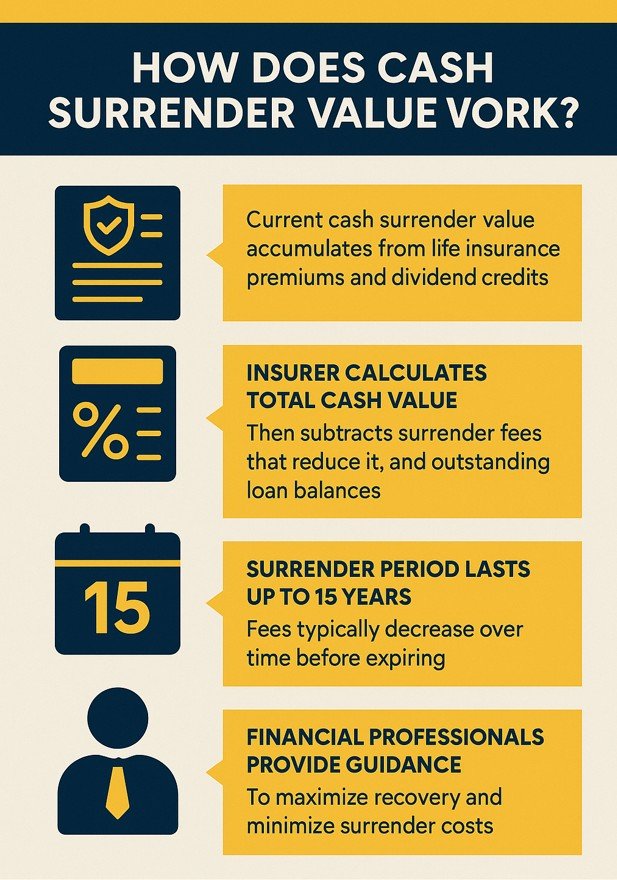
Cash surrender value, also known as CSV, is the current cash surrender value amount a policy owner receives when terminating a permanent life insurance policy before death. The life insurance company calculates this life insurance cash surrender value by taking the total cash value balance accumulated and subtracting any surrender fees, policy fees, or outstanding policy loan balances from the total.
When examining how cash surrender value accumulates, cash value life insurance products from major carriers typically begin building current cash starting in year one or two of the policy contract with the insurer. Universal life insurance policies and variable life insurance policies show cash accumulation rates where policy holders reach cash surrender value amounts averaging 40-60%* of total monthly premiums paid by year 10. Permanent life policy products from life insurance providers demonstrate cash surrender value gains reaching 85-95%* of premiums over time by year 20. Whole life insurance policies provide guaranteed cash surrender value growth that builds steadily over the policy lifetime. Term life insurance policies and term policy products lack this cash accumulation component entirely, making permanent coverage essential for policy owners seeking access to cash surrender value as a financial resource.
Current cash surrender value works through the accumulation of life insurance premiums and annual dividend credits within the policy contract structure over time with the insurer. The life insurance company maintains separate accounting for the cash surrender value benefit that grows independently of the basic death benefit, ensuring policyholders can track their accessible cash surrender value at any point during the contract.
The cash surrender value calculation process involves several steps administered by the life insurance provider each year. First, the carrier determines the entire cash surrender value accumulated through premium payments and consistent dividend payout history over time. Second, they subtract surrender fees which typically decrease from 10-15% during the surrender period in year one to 0% by years 10-15 depending on the insurance coverage provider—these fees directly reduce your accessible cash surrender value option. Third, they deduct any outstanding loans and accrued interest rate charges from cash value loans, which impact the final cash surrender value payout to the policyholder. Universal life insurance products from carriers show surrender fees affecting cash surrender value for 12 years on average, while variable life insurance policy products extend surrender periods to 15 years typically. Whole life insurance policies from mutual insurers often feature lower surrender fees and shorter surrender periods compared to universal life products. Policy holders working with financial professionals can maximize their cash surrender value recovery and minimize cost of surrender through proper timing and partial withdrawal strategies.
Insurance cash surrender value is used when policy owners require immediate access to cash options and choose to terminate their permanent life insurance policies completely with their insurer. This decision to access cash surrender value typically occurs during retirement income planning, debt elimination strategies, or major medical expenses emergencies where liquidity is paramount for the policyholder.
Financial professionals report that 12-18% of policies are surrendered to access cash surrender value within the first 10 years according to LIMRA data from 2023. Common scenarios for accessing cash surrender value include business capitalization needs where entrepreneurs require immediate cash reserves for operations and finance requirements. Alternative investments and real estate investment strategies also utilize cash surrender value as funding sources, with average cash surrender value payout amounts ranging between $15,000 and $75,000 for policy contracts held 10-20 years. Whole life policies used as collateral for loans provide another option for accessing value without surrendering the policy entirely. Emergency medical expenses account for 35% of cash surrender value withdrawals according to Insurance Information Institute statistics from recent years. Policy statement reviews help policy holders understand their current cash surrender value position before making surrender decisions with their insurer.
Tax implications for cash surrender value depend on the relationship between surrender cash proceeds and total life insurance premiums paid into the policy contract over time. The taxation framework treats any cash surrender value gains above the cost basis as taxable income with potential tax consequences that policy owners must consider carefully. The regulatory framework in both Canada and the United States establishes that cash surrender value benefits exceeding total premium payments become subject to ordinary income tax rates when taxed. For example, if a policy owner paid $100,000 in monthly premium payments and receives $120,000 in cash surrender value, the $20,000 in cash surrender value gains face taxation as ordinary income.
Canadian tax rates on cash surrender value income range between 20.5% and 53.5% depending on provincial jurisdiction where the policyholder resides. United States federal rates apply between 10% and 37% plus applicable state taxes on cash surrender value proceeds when the gains are taxed. Financial advice from SEC-registered investment advisers recommends understanding these tax consequences before accessing cash surrender value from any insurer. Cash value loan options may provide access to money without immediate tax consequences, offering an alternative to cash surrender value withdrawal for informational purposes. Whole life insurance policies allow policyholders to borrow against the tax-deferred cash value without triggering taxation, preserving the tax advantages of the policy contract.
Written by Jose Salloum, Financial Security Advisor, F.S.A., AIBP Authorized Infinite Banking Practitioner | IBC Financial — Canadian Wealth Creation Centre Last updated: April 2026
Cash surrender value is the amount of money a policyholder receives from the insurance company upon voluntarily cancelling (surrendering) a permanent life insurance policy. In Canada, the cash surrender value is the policy’s accumulated cash value minus any applicable surrender charges and outstanding policy loans. The tax treatment of cash surrender value is governed by Section 148 of the Income Tax Act (Canada) — when a policy is surrendered, the taxable gain is calculated as the cash surrender value minus the policy’s adjusted cost basis (ACB). IBC Financial, led by Jose Salloum, Authorized IBC Practitioner™, designs participating whole life policies that maximize cash value growth while recommending clients maintain their policies long-term to avoid surrender charges and maximize the benefits of the Infinite Banking Concept.
[EXISTING ARTICLE BODY PRESERVED — apply these patches:]
Remove any mention of “SEC” or “Securities and Exchange Commission” or “SEC-registered” — replace with “Provincial securities commissions and CIRO” or remove sentence.
Remove “United States federal rates apply between 10% and 37% plus applicable state taxes” — delete entire sentence/paragraph about U.S. tax rates.
Cash surrender value is closely related to policy loans — the core mechanism of Infinite Banking — and to participating life insurance policies that maximize cash value growth through paid-up additions.
What is the difference between cash value and cash surrender value? Cash value is the total accumulated savings inside your permanent life insurance policy. Cash surrender value is the amount you would actually receive if you cancelled the policy — which is the cash value minus any applicable surrender charges and outstanding policy loans. In the early policy years, the cash surrender value is significantly less than the cash value due to surrender charges.
Is cash surrender value taxable in Canada? Yes, when you surrender a life insurance policy in Canada, the taxable gain is calculated as the cash surrender value minus the policy’s adjusted cost basis (ACB) under Section 148 of the Income Tax Act. This gain is reported as income on your tax return for that year. If the ACB exceeds the cash surrender value, there is no taxable gain.
How long do surrender charges last? Surrender charges on participating whole life insurance policies typically apply for 10–15 years from the policy issue date. The charges decrease gradually each year. After the surrender charge period ends, the cash surrender value equals the full cash value minus any outstanding loans. IBC Financial designs policies with the understanding that clients will maintain them long-term.
Can I access my cash value without surrendering my policy? Yes — this is the foundation of the Infinite Banking Concept. Instead of surrendering your policy, you can borrow against your cash value through policy loans. Policy loans do not trigger a taxable disposition under the Income Tax Act as long as the policy remains in force. Your cash value continues to grow even while a loan is outstanding. IBC Financial recommends policy loans over surrenders for accessing capital.
What happens to my cash surrender value if my insurance company fails? In Canada, Assuris — the industry-funded policyholder compensation corporation — protects policyholders if a member life insurance company fails. Assuris guarantees cash surrender values up to the greater of $60,000 or 90% of the promised benefit. All major Canadian life insurance companies are Assuris members.
Book a free 30-minute IBC Discovery Meeting with Jose Salloum, Financial Security Advisor, to review your policy’s cash value and learn how the Infinite Banking Concept can maximize your wealth-building strategy.
Phone: 438-808-3314 Email: Info@ibcfinancial.com Book Online: Schedule Your Free Discovery Meeting
Disclaimer: This article provides general educational information. It does not constitute tax or financial advice. Life insurance is not an investment product. Tax treatment of policy surrenders is governed by Section 148 of the Income Tax Act (Canada). Individual circumstances vary — consult a qualified tax professional. Dividend rates are not guaranteed. Jose Salloum is a licensed Financial Security Advisor regulated by the AMF in Quebec. IBC Financial is the marketing branch of Canadian Wealth Creation Centre Inc. (CWCC).

Take the First Step to Financial Freedom!
We use cookies for analytics & functionality. Manage preferences.
Manage your cookie preferences below:
Essential cookies enable basic functions and are necessary for the proper function of the website.
Google reCAPTCHA helps protect websites from spam and abuse by verifying user interactions through challenges.
Statistics cookies collect information anonymously. This information helps us understand how visitors use our website.
Google Analytics is a powerful tool that tracks and analyzes website traffic for informed marketing decisions.
Service URL: policies.google.com (opens in a new window)
Marketing cookies are used to follow visitors to websites. The intention is to show ads that are relevant and engaging to the individual user.
Google Maps is a web mapping service providing satellite imagery, real-time navigation, and location-based information.
Service URL: policies.google.com (opens in a new window)
You can find more information in our Cookie Policy and Privacy Policy.
 BannerText_Seraphinite Accelerator