

Corporate-Owned Life Insurance or COLI, is a type of life insurance policy a company buys on its employees. Corporate-Owned Life Insurance is also bought for managers, large investors, and key shareholders. According to a report by Statista, the Canadian life insurance market is all set to reach $34.69 billion in 2025.
Clearly, the Canadian market is thriving with demand for both family-bought and corporate-owned life insurance. In the case of COLI, the business is the policyholder and the life insurance beneficiary. Hence, it pays premiums and receives death benefits when a covered employee dies.
There are various reasons for companies to use life insurance as part of their overall strategy. Now, we’ll discuss the finer details of corporate ownership of life insurance and understand how it works. In case you need professional legal advice on life insurance in Canada, contact the IBC Financial team now.
Corporate-Owned Life Insurance (COLI) is a policy that an organization purchases for its key employees, managers, or shareholders. COLI helps protect against the loss of valuable workers by paying death benefits if the insured person passes away and serving as a vehicle for financing employee benefits, retirement programs, and deferred compensation.
Here are the multiple strategic reasons why companies purchase COLI:
Key Person Insurance: Insurance purchased by an employer to protect against unforeseen Revenue loss and financial damage to the health of the business in the event of a key employee or manager dying.
Succession Planning: Arranging for liquidity for shareholder buyouts, debt repayment, and business acquisition. It can also help with other financial liabilities in case of an untimely exit of an executive.
Deferred Compensation Financing: Helping finance executive compensation and retirement benefits. This also includes non-qualified deferred compensation programs.
Tax Benefits: The tax-deferred growth of cash values and the tax-free death benefits are possible under a well-structured COLI policy that minimizes taxes and taxation burdens.
In a nutshell, it’s a strategic financing vehicle for managing the risk of loss of critical talent. Also, it aids in financing a wide array of corporate financial obligations while enhancing shareholder value. To structure efficient company-owned life insurance policies through a proper contract with an experienced insurer, contact the IBC Financial experts.
Corporate-Owned Life Insurance works by identifying key employees, managers, and shareholders as a starting point. COLI policies work when firms pay life insurance premiums to the insurer.
As per an article by Joelle Hall in Financial Post, titled “From liability to asset: Tapping the potential of insurance to maximize wealth,” life insurance for key people is a great way for Canadian business owners to mitigate risk. Take a look at how the policy actually operates:
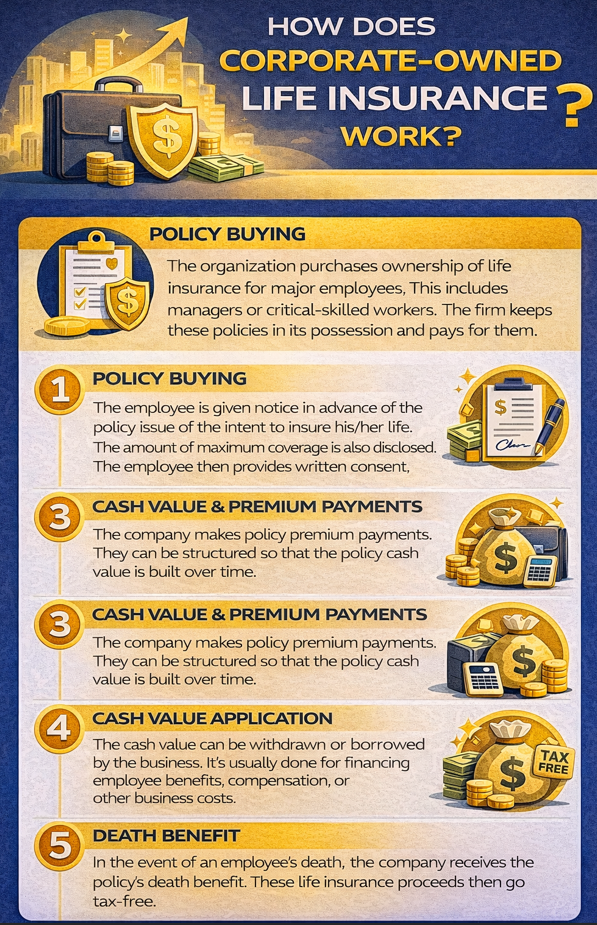
Policy Buying: The organization purchases ownership of life insurance for major employees, managers, shareholders, or critical-skilled workers. The firm keeps these policies as corporate investments and pays premiums paid to maintain coverage.
Notice and Consent: The employee is given notice in advance of the policy issuance regarding the intent to insure his/her life under the contract. The amount of maximum coverage is also disclosed. The employee then provides written consent through the underwriting process, assuring his/her agreement on the arrangement.
Cash Value and Premium Payments: After that, the employer makes policy premium payments that appear on the balance sheet. They can be structured through careful policy design so that the policy cash value is built over time with the cost basis tracked appropriately.
Cash Value Application: Please note that the cash value can be withdrawn or borrowed by the business through loans. It’s usually done for financing employee benefits, retirement programs, compensation, or other business costs without being taxed at the time of borrowing.
Death Benefit: In the event of an employee’s death, the company receives the policy’s death benefits. These life insurance proceeds then pass tax-free under Income Tax rules.
The proceeds can be used for the following needs:
The policy transactions must be handled carefully since loans can reduce the policy’s death benefits. Moreover, they also have tax implications related to taxation even though premiums paid are not tax-deductible deductions. With the guidance of IBC Financial experts, risk management is more accessible than ever.
Written by Jose Salloum, Financial Security Advisor, F.S.A., AIBP Authorized Infinite Banking Practitioner | IBC Financial — Canadian Wealth Creation Centre Last updated: April 2026
Corporate-owned life insurance (COLI) is a life insurance policy purchased and owned by a corporation on the life of a key person, shareholder, or employee. In Canada, COLI provides significant tax advantages under the Income Tax Act (Canada): cash value grows tax-deferred inside the corporation, and upon the death of the insured, the death benefit minus the policy’s adjusted cost basis (ACB) can be credited to the corporation’s Capital Dividend Account (CDA), enabling tax-free capital dividend distributions to shareholders. IBC Financial, led by Jose Salloum, Authorized IBC Practitioner™, designs corporate Infinite Banking strategies using participating whole life COLI policies for Canadian business owners.
COLI integrates with succession planning for business ownership transitions and estate planning for tax-efficient wealth transfer to the next generation.
[EXISTING ARTICLE BODY — Remove “investment component that appears on the balance sheet” → “tax-advantaged asset on the corporation’s balance sheet.” Remove “Dead Peasant Insurance” → “COLI has a controversial history related to policies purchased on employees without their knowledge or consent.”]
How does the Capital Dividend Account work with COLI? When the insured on a COLI policy dies, the death benefit minus ACB is credited to the CDA. The corporation can distribute this as tax-free capital dividends to shareholders.
Can a corporation borrow against COLI cash value? Yes, through policy loans without triggering a taxable disposition, as long as the policy remains in force. IBC Financial designs corporate IBC strategies leveraging COLI policy loans.
Is COLI tax-deductible for the corporation? Premiums are generally not deductible. When used as loan collateral, a portion may be deductible under specific CRA provisions. The primary advantage is tax-deferred growth and the CDA credit.
What types of businesses use COLI in Canada? Incorporated professionals, family-owned businesses, corporations with key person risk, businesses with buy-sell agreements, and business owners implementing corporate Infinite Banking.
How does COLI provide creditor protection? COLI cash value is generally accessible only to the corporation’s creditors — not the personal creditors of the insured shareholder, providing a layer of asset protection.
Phone: 438-808-3314 | Email: Info@ibcfinancial.com | Book Online: Schedule Your Free Discovery Meeting
Disclaimer: General educational information. Not financial, tax, or legal advice. Life insurance is not an investment product. Dividend rates not guaranteed. Jose Salloum is regulated by the AMF in Quebec. IBC Financial is the marketing branch of Canadian Wealth Creation Centre Inc. (CWCC).

Take the First Step to Financial Freedom!
We use cookies for analytics & functionality. Manage preferences.
Manage your cookie preferences below:
Essential cookies enable basic functions and are necessary for the proper function of the website.
Google reCAPTCHA helps protect websites from spam and abuse by verifying user interactions through challenges.
Statistics cookies collect information anonymously. This information helps us understand how visitors use our website.
Google Analytics is a powerful tool that tracks and analyzes website traffic for informed marketing decisions.
Service URL: policies.google.com (opens in a new window)
Marketing cookies are used to follow visitors to websites. The intention is to show ads that are relevant and engaging to the individual user.
Google Maps is a web mapping service providing satellite imagery, real-time navigation, and location-based information.
Service URL: policies.google.com (opens in a new window)
You can find more information in our Cookie Policy and Privacy Policy.
 BannerText_Seraphinite Accelerator