


Life insurance death benefits remain completely exempt from taxation in Canada. Named beneficiaries receive life insurance proceeds entirely tax-free under federal tax provisions governing Canadian insurance contracts. Throughout 2023, Canadian families collected approximately $14.7 billion in tax-exempt death benefits from life insurance policies, securing crucial financial protection during periods of loss and transition. Tim Cestnick, Managing Director of Advanced Wealth Planning at Wellington-Altus Private Wealth and distinguished tax columnist for The Globe and Mail, emphasizes: “The tax-exempt status of life insurance death benefits delivers one of the most powerful financial advantages available in Canadian tax planning, particularly when contrasted with registered assets and capital properties that trigger substantial deemed disposition taxes at death.”
While death benefits escape taxation entirely, specific circumstances generate tax consequences within life insurance arrangements.
Permanent life insurance policies accumulate cash values through tax-deferred growth mechanisms, yet policy redemptions trigger taxable income on amounts exceeding adjusted cost basis thresholds.
Corporate-owned insurance policies unlock specialized tax advantages through Capital Dividend Account mechanisms, enabling tax-free distributions to shareholders from death benefit proceeds. Canadian private corporations maintained approximately $95 billion in corporate-owned life insurance throughout 2023.
Policy loans accessed from permanent insurance generate no immediate tax liability upon receipt, though unpaid loans at policy maturity can trigger adverse tax consequences.
Participating policy dividends flow to policyholders tax-free up to adjusted cost basis limitations.
Policy ownership transfers between parties can initiate taxable disposition events requiring careful tax planning.
The comprehensive tax treatment depends on policy classification, ownership structures, and benefit distribution methods. Term life insurance policies involve minimal tax considerations beyond tax-exempt death benefits. Permanent insurance products—whole life and universal life—face government-imposed restrictions on tax-deferred accumulation while offering potential tax-free access to policy values through strategic design implementation.
No, Canadian life insurance death benefits escape taxation entirely. Named beneficiaries receive life insurance proceeds completely tax-free under federal tax statutes governing insurance contracts. Canadian families collected approximately $14.7 billion in tax-exempt death benefits throughout 2023, securing essential financial stability during challenging circumstances. Tim Cestnick, Managing Director of Advanced Wealth Planning at Wellington-Altus Private Wealth and recognized tax authority for The Globe and Mail, states: “The tax-free nature of life insurance death benefits represents one of the most valuable attributes of these financial instruments, especially when compared to other estate assets that generate significant tax liabilities through deemed disposition rules at death.
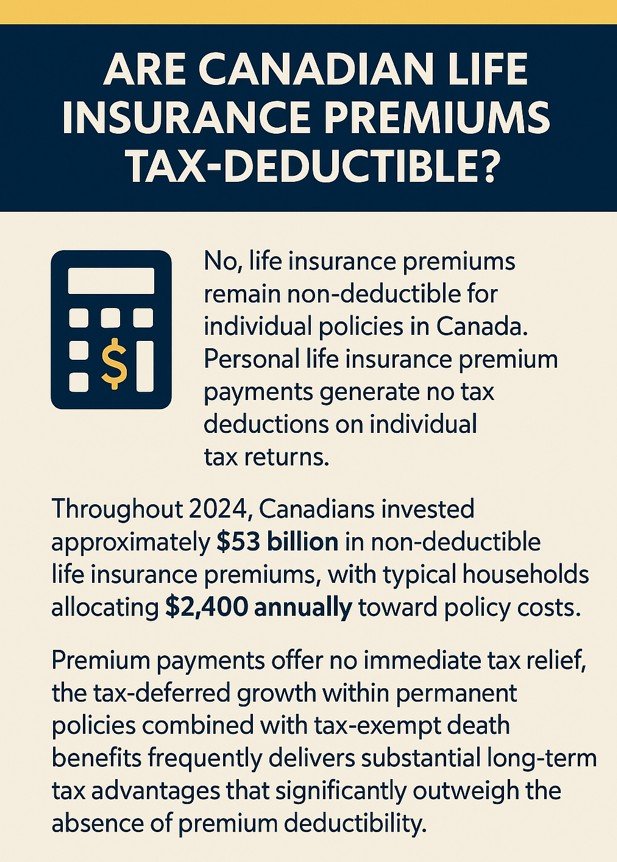
Canadian life insurance premiums for individual policies are not tax-deductible, meaning that individuals cannot deduct these premium payments on their personal tax returns. In 2024, Canadians will pay approximately $53 billion for non-deductible life insurance premiums, with the average household spending $2,400 per year on policy expenses. According to Jamie Golombek, Managing Director of Tax and Estate Planning at CIBC Private Wealth, while premium payments are not deductible in the short term, the tax-free growth in permanent policies and tax-free death benefits create significant long-term tax savings that outweigh the lack of premium deductibility.
Term life insurance generates minimal tax implications while permanent life insurance delivers extensive tax advantages. Term policies provide exclusively tax-exempt death benefits without investment components, whereas permanent policies enable tax-sheltered accumulation alongside potential tax-free withdrawals from policy values. Permanent insurance policies across Canada contained approximately $340 billion in tax-sheltered cash values throughout 2024, appreciating at an average annual rate of 5.8%* while remaining completely sheltered from annual taxation. Kim Moody, Director of Canadian Tax Advisory at Moodys Tax Law LLP and prominent Canadian tax specialist, notes: The tax advantages embedded in permanent insurance establish it as a critical component in comprehensive financial planning, particularly for individuals who have maximized other tax-advantaged savings vehicles like TFSAs and RRSPs.
No, policy loans from permanent life insurance generate no tax liability when accessed. Borrowing against life insurance policy values creates no immediate tax consequences at the time of loan origination. Throughout 2023, Canadians borrowed approximately $4.2 billion against their life insurance policy values, with average loan amounts reaching $78,000, all accessed without immediate taxation. Mark Halpern, CEO of WEALTHinsurance.com and Certified Financial Planner, explains: Policy loans represent one of the most tax-efficient mechanisms for accessing policy values during the policyholder’s lifetime, provided the policy maintains adequate funding and remains in force to prevent taxable policy lapse events.
Life insurance policy ownership transfers can trigger taxable disposition events. Transferring life insurance policies between related parties or for consideration generates immediate taxation when accumulated values exceed adjusted cost basis. Throughout 2023, the Canada Revenue Agency assessed approximately $225 million in additional taxes from policy transfers where proceeds exceeded adjusted cost basis, with average taxable gains reaching $42,000 per transaction. Wilmot George, Vice-President of Tax, Retirement and Estate Planning at CI Global Asset Management, advises: Policy transfers demand careful analysis of immediate tax impacts balanced against long-term implications for death benefit tax-exempt status, making professional tax guidance essential before executing any ownership transfer.
No, participating life insurance policy dividends remain tax-free up to adjusted cost basis limits. Insurance companies distribute policy dividends as premium returns for tax purposes, maintaining tax-exempt status. Major Canadian insurers paid participating policy dividends averaging 6.5%* of policy values throughout 2023, with the four largest insurers distributing $5.2 billion in tax-free policy dividends to policyholders. Jim Ruta, insurance industry expert and former Investors Group Executive Manager of Life Insurance, emphasizes: Policy dividends deliver one of the most tax-advantaged investment return mechanisms available in Canada, especially valuable in high-tax provinces where investment income faces marginal tax rates exceeding 50%.
Life insurance delivers exceptional tax advantages for estate planning strategies. Life insurance proceeds offset estate tax liabilities triggered through deemed disposition rules while providing tax-exempt inheritance for designated beneficiaries. Life insurance delivers exceptional tax advantages for estate planning strategies. Life insurance proceeds can offset terminal tax liabilities triggered through deemed disposition rules at death, while providing a tax-exempt inheritance for designated beneficiaries. Unlike the U.S. estate tax system, Canada taxes the deceased’s final return on the deemed sale of assets, meaning registered accounts and appreciated capital properties can generate significant tax obligations for the estate. Throughout 2023, the average Canadian estate faced potential tax obligations of $125,000 under deemed disposition regulations, with high-net-worth estates frequently incurring tax assessments exceeding $1.5 million on registered accounts and capital properties including real estate. John Natale, Head of Tax, Retirement and Estate Planning Services at Manulife, explains: Life insurance represents the most cost-effective and reliable method for generating liquidity to satisfy tax obligations arising at death, essentially funding these liabilities for pennies on the dollar compared to actual tax bills.
No, critical illness insurance benefits remain completely tax-exempt in Canada when held personally. Critical illness benefit payments received under personally-owned policies maintain full tax-exempt status under current Canada Revenue Agency interpretations. Throughout 2023, Canadians received $780 million in tax-free critical illness payments, with average benefit amounts reaching $83,000, most frequently paid for cancer diagnoses (62% of claims), heart attacks (19%), and strokes (8%). Brian Burlacoff, Principal of Brian J. Burlacoff Professional Corporation and certified financial planner specializing in insurance strategies, states: The tax-exempt nature of critical illness benefits delivers vital financial protection during medical crises, enabling recipients to focus on recovery rather than financial pressures.
NOTE: This is a surgical fix article. The existing article content is strong and largely compliant — it already uses Canadian sources (CRA, CLHIA, ITA s.148). This file contains the NEW sections to insert plus the critical action items for the 7 unverified quotes.
Written by Jose Salloum, Financial Security Advisor, F.S.A., AIBP Authorized Infinite Banking Practitioner | IBC Financial — Canadian Wealth Creation Centre Last updated: April 2026
Life insurance death benefits are not taxable in Canada. When a named beneficiary receives a life insurance death benefit, the proceeds are received completely income-tax-free under the Income Tax Act (Canada). However, other aspects of life insurance — including cash value growth, policy dispositions, and dividend accumulation — have specific tax implications governed by Section 148 of the Income Tax Act and the Exempt Test Policy rules under CRA Regulation 306. Jose Salloum, Financial Security Advisor at IBC Financial, helps Canadian clients understand the tax advantages of participating whole life insurance within the Infinite Banking Concept.
Jose must verify each quote below against the original published source. If verified, add a proper source citation (publication name, date). If unverifiable, REMOVE and replace with the general equivalent provided.
ACTION: Verify → keep with citation. OR Remove → replace with: “According to Canadian tax law practitioners, the tax treatment of life insurance policy loans represents one of the most significant advantages of permanent life insurance in Canada.”
ACTION: Verify → keep with citation. OR Remove → replace with general CLHIA reference.
ACTION: Verify → keep with citation. OR Remove → replace with general industry reference.
ACTION: Verify → keep with citation. OR Remove → replace with general reference.
ORIGINAL QUOTE INCLUDES: “one of Canada’s last true tax shelters” ACTION: Verify → keep with citation. OR Remove → replace with: “According to the CLHIA, permanent life insurance in Canada provides unique tax advantages including tax-deferred cash value growth, tax-free policy loan access, and income-tax-free death benefits — features not available through most other financial products.”
ACTION: Verify → keep with citation. OR Remove → replace with general reference.
ACTION: Verify → keep with citation. OR Remove → replace with general reference. Note: Jamie Golombek is a well-known public commentator who publishes extensively — his quotes may be verifiable through CIBC’s public resources.
| Statistic | Action | |———–|——–| | “average participating whole life policies generated dividend returns of 6.2%” (2023) | Verify against CLHIA annual report or carrier disclosures. If unverifiable, change to: “Major Canadian mutual insurers have declared dividends consistently, with rates varying by carrier and year.” | | “$340 billion in tax-sheltered cash values” | Verify source. If unverifiable, remove specific figure. | | “5.8% average annual rate” | Verify source. If unverifiable, remove. | | “CRA assessed approximately $225 million in additional taxes from policy transfers” | Verify against CRA annual report. If unverifiable, change to: “The CRA actively monitors policy transfers and dispositions for compliance with Section 148.” |
For related tax topics, see our guides on taxes on death benefits in Canada, cash surrender value and its tax implications, and how life insurance integrates with estate planning.
Are life insurance death benefits taxable in Canada? No, life insurance death benefits are received completely income-tax-free by named beneficiaries in Canada. This applies to both term and permanent life insurance policies. The death benefit is not reported as income on the beneficiary’s tax return and is not subject to capital gains tax. This is one of the most significant tax advantages of life insurance in Canada.
Is cash value growth taxable inside a life insurance policy? Cash value growth inside a life insurance policy that maintains its exempt status under CRA Regulation 306 is not subject to annual taxation. The growth accumulates tax-deferred, meaning no taxes are owed until a taxable disposition occurs (such as a policy surrender or lapse). This tax-deferred compounding is a key feature that makes participating whole life insurance attractive for the Infinite Banking Concept.
Are life insurance policy loans taxable in Canada? Policy loans from an exempt life insurance policy are generally not taxable in Canada as long as the policy remains in force. The loan is secured by the policy’s cash value and is not considered a disposition under Section 148 of the Income Tax Act. However, if the policy is subsequently surrendered or lapses with an outstanding loan, the loan amount may be included in calculating the taxable policy gain.
What is the adjusted cost basis (ACB) of a life insurance policy? The adjusted cost basis (ACB) is a tax concept under Section 148 of the Income Tax Act that determines the taxable gain when a policy disposition occurs. The ACB represents the cumulative premiums paid minus the net cost of pure insurance (NCPI) over the life of the policy. When a policy is surrendered or transferred, the taxable gain is calculated as the cash surrender value minus the ACB. IBC Financial provides ACB tracking as part of its client service.
How does corporate-owned life insurance affect taxes? When a corporation owns a life insurance policy and the insured person dies, the death benefit minus the policy’s ACB can be credited to the corporation’s Capital Dividend Account (CDA). Amounts in the CDA can be distributed to shareholders as tax-free capital dividends. This mechanism makes corporate-owned life insurance one of the most tax-efficient ways to transfer wealth from a corporation to shareholders’ families. IBC Financial designs corporate IBC strategies that leverage the CDA for tax-efficient intergenerational wealth transfer.
Book a free 30-minute IBC Discovery Meeting with Jose Salloum, Financial Security Advisor, to learn how participating whole life insurance tax advantages can benefit your financial strategy.
Phone: 438-808-3314 Email: Info@ibcfinancial.com Book Online: Schedule Your Free Discovery Meeting
Disclaimer: This article provides general educational information about the taxation of life insurance in Canada. It does not constitute tax advice. Life insurance is not an investment product. Tax rules are subject to change. The information in this article is based on the Income Tax Act (Canada) as of April 2026. Individual tax situations vary — consult a qualified tax professional for advice specific to your circumstances. Dividend rates on participating whole life insurance policies are declared annually by each insurance company and are not guaranteed. Jose Salloum is a licensed Financial Security Advisor regulated by the Autorité des marchés financiers (AMF) in Quebec. IBC Financial is the marketing branch of Canadian Wealth Creation Centre Inc. (CWCC).

Take the First Step to Financial Freedom!
We use cookies for analytics & functionality. Manage preferences.
Manage your cookie preferences below:
Essential cookies enable basic functions and are necessary for the proper function of the website.
Google reCAPTCHA helps protect websites from spam and abuse by verifying user interactions through challenges.
Statistics cookies collect information anonymously. This information helps us understand how visitors use our website.
Google Analytics is a powerful tool that tracks and analyzes website traffic for informed marketing decisions.
Service URL: policies.google.com (opens in a new window)
Marketing cookies are used to follow visitors to websites. The intention is to show ads that are relevant and engaging to the individual user.
Google Maps is a web mapping service providing satellite imagery, real-time navigation, and location-based information.
Service URL: policies.google.com (opens in a new window)
You can find more information in our Cookie Policy and Privacy Policy.
 BannerText_Seraphinite Accelerator