


Max-funded IUL is an Indexed Universal Life (IUL) insurance policy strategically designed to maximize cash value accumulation alongside life insurance protection. Unlike traditional policies focused primarily on death benefits, a max-funded IUL approach emphasizes building substantial cash value by contributing the maximum allowable premiums. This permanent insurance vehicle combines a death benefit with a cash value component that earns interest tied to market index performance. The cash value component grows based on index returns while offering downside protection against market losses.
The max-funded IUL strategy involves contributing as much premium as legally permitted while ensuring the policy continues to pass Canada’s Exempt Test Policy (ETP) requirements under Regulation 306 of the Income Tax Act. Instead of paying only the minimum required premiums, policyholders intentionally maximize their contributions to accelerate cash value growth. Properly structuring a max-funded IUL requires expertise to optimize contributions while maintaining tax advantages under Canadian law. This is where IBC Financial’s specialists can help you navigate the complex CRA regulations and maximize your policy’s potential.
Key characteristics of max-funded IUL include:
People who pursue the max-funded IUL strategy typically seek both permanent life insurance protection and long-term, tax-advantaged wealth accumulation. With IBC Financial at your side, you have access to experienced Canadian advisors who specialize in designing max-funded IUL strategies tailored to your unique financial situation, helping you build wealth and secure your financial future.
Read ahead to discover everything about max-funded IUL strategies and determine if this approach aligns with your financial goals. We’ll explore the mechanics, benefits, potential drawbacks, and optimal applications of maximum-funded indexed universal life insurance in the Canadian context. When you’re ready to explore whether max-funded IUL is right for you, IBC Financial offers complimentary consultations to assess your needs and design a customized strategy.
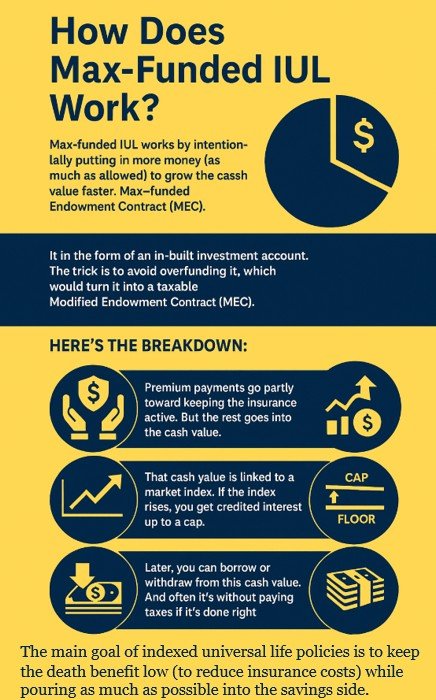
Max-funded IUL works by strategically contributing maximum allowable premiums to accelerate cash value growth within the policy’s indexed crediting structure. The max-funded IUL approach differs fundamentally from traditional life insurance, which focuses on minimum premium payments sufficient only to maintain death benefit coverage.
You can conceptualize max-funded IUL as life insurance with an integrated investment-style accumulation account. The key to successful max-funding in Canada is staying below the contribution limits defined by the Exempt Test Policy under Regulation 306 of the Income Tax Act to ensure your policy maintains its exempt status. If a policy fails the Exempt Test, cash value growth may become annually taxable — eliminating the key tax advantage that makes max-funded IUL attractive. IBC Financial’s advisors use proprietary calculators and industry expertise to determine your precise maximum funding level, ensuring you get optimal growth without crossing into non-exempt territory.
Here’s how the max-funded IUL mechanism operates:
The primary objective of max-funded indexed universal life policies is minimizing the death benefit (thereby reducing insurance costs) while maximizing contributions to the cash value component. This strategic approach transforms the IUL from simple death benefit coverage into a dual-purpose wealth accumulation and protection vehicle optimized for long-term financial planning. Getting the balance right requires careful policy design — IBC Financial works with top-rated Canadian insurance carriers to structure max-funded IUL policies that align with your wealth-building objectives while minimizing costs.
Max-funded IUL is a good idea if you need permanent life insurance protection combined with tax-advantaged wealth building potential. Whether a max-funded IUL strategy suits your situation depends on individual financial circumstances, goals, and risk tolerance.
The max-funded approach offers compelling benefits for income replacement, retirement income supplementation, and accelerated cash value accumulation. For some Canadians, max-funded IUL represents a powerful financial tool that complements registered accounts like RRSPs and TFSAs. For others, the complexity and cost structure may outweigh potential advantages.
Max-funded IUL makes sense if you:
However, max-funded IUL strategies involve notable drawbacks:
For individuals with long-term wealth-building objectives and appropriate budgets, max-funded IUL can provide powerful financial leverage. However, this strategy isn’t universally optimal for everyone. The decision requires careful analysis of your complete financial picture — schedule a consultation with IBC Financial’s experts to receive a personalized assessment of whether a max-funded IUL approach aligns with your family’s financial objectives and circumstances. Our team will compare max-funded IUL against other wealth-building strategies, including RRSPs, TFSAs, and corporate-owned life insurance, to determine the optimal solution for you.
The benefits of max-funded IUL include accelerated cash value growth, market downside protection, and tax-advantaged wealth accumulation. Max-funded IUL strategies also deliver flexibility in accessing accumulated funds and permanent death benefit protection. The floor protection feature shields your cash value from market dips and volatility.
The fundamental appeal of max-funded indexed universal life insurance lies in combining permanent insurance protection with a flexible, tax-advantaged wealth accumulation vehicle. The five primary benefits include:
This combination of market-linked growth potential with downside protection and tax benefits explains why higher-income Canadians and long-term planners frequently consider max-funded IUL strategies — particularly those who have maximized their registered plan contributions. IBC Financial specializes in maximizing these benefits through strategic policy design and ongoing management. Our clients receive comprehensive support including annual policy reviews, optimization recommendations, and access to premium carriers offering competitive caps and participation rates.
The downside of IUL includes lower guaranteed minimum interest rates compared to traditional participating whole life insurance. IUL policies also impose participation caps limiting your potential returns during strong market performance. Cash value growth directly correlates with market index performance, creating return variability from year to year.
Strong index performance can substantially increase IUL cash value. The S&P 500 index — comprising 500 companies representing approximately 80% of U.S. market capitalization — serves as the most popular benchmark for IUL crediting, though some Canadian carriers also offer crediting linked to the S&P/TSX Composite Index. When compared to guaranteed universal life insurance or participating whole life policies offered by Canadian insurers, the interest crediting rates for IUL involve more uncertainty. Additionally, participation caps on index gains affect both max-funded IUL and standard indexed universal life policies due to the insurance company’s hedging costs.
The complexity inherent in IUL products — with multiple variables affecting performance — makes these policies difficult for many consumers to fully understand. Multiple fee layers, including mortality charges, administrative costs, and premium expense charges, can substantially diminish net returns and policy performance. Without careful policy monitoring and adequate funding, an IUL policy may underperform expectations or even lapse. Canadian consumers should ensure they work with an advisor who holds appropriate provincial licensing and is experienced with exempt policy rules under the Income Tax Act.
Max-funded IUL is ideal for Canadians seeking permanent life insurance that emphasizes both cash accumulation and death benefit protection. The max-funded IUL approach particularly benefits those prioritizing tax-free death benefits combined with living benefits through cash value access.
Sophisticated investors seeking flexible policies with growth potential find max-funded IUL strategies particularly beneficial — especially Canadian business owners, incorporated professionals, and high-income earners who have exhausted their RRSP and TFSA room. For incorporated professionals such as physicians, dentists, lawyers, and engineers, a corporate-owned max-funded IUL can offer additional tax planning advantages by leveraging retained earnings within a corporation.
While max-funded IUL offers numerous advantages, it involves higher costs than term life insurance, making consultation with a qualified Canadian financial advisor crucial to determine alignment with your long-term strategy. This strategy works well as a component of comprehensive estate planning, business succession planning, and premium-financing arrangements for high-net-worth Canadians.
At IBC Financial, we provide comprehensive financial solutions enabling you to maximize wealth through strategic max-funded IUL implementation. Our advisors have helped hundreds of Canadian clients structure policies that deliver optimal results — we’ll analyze your income, tax situation, retirement goals, and estate planning needs to determine if max-funded IUL should be part of your strategy. We also help you compare this approach against alternatives like participating whole life insurance, RRSPs, TFSAs, and other wealth-building vehicles. Contact us today to receive your personalized max-funded IUL analysis.
Written by Jose Salloum, Financial Security Advisor, F.S.A., AIBP Authorized Infinite Banking Practitioner | IBC Financial — Canadian Wealth Creation Centre Last updated: April 2026
A max-funded IUL (Indexed Universal Life) is a universal life insurance policy structured to maximize premium contributions and accelerate cash value growth through interest crediting linked to a market index. In Canada, both IUL and participating whole life insurance are permanent life insurance products regulated by the Office of the Superintendent of Financial Institutions (OSFI), with tax treatment governed by the Income Tax Act (Canada) and the Exempt Test Policy rules under CRA Regulation 306. However, they are fundamentally different products with different risk profiles, guarantees, and philosophical foundations. IBC Financial, led by Jose Salloum, Authorized IBC Practitioner™, recommends participating whole life insurance — not IUL — as the foundation for the Infinite Banking Concept, consistent with the methodology created by R. Nelson Nash.
A max-funded IUL is an Indexed Universal Life insurance policy where the policyholder contributes the maximum allowable premiums to accelerate cash value growth. Unlike a standard IUL where premiums cover primarily the cost of insurance, a max-funded approach directs the majority of premium dollars into the cash value component, which earns interest credits linked to a market index such as the S&P/TSX Composite or the S&P 500.
The cash value in a max-funded IUL typically has a floor (often 0% or 1%) that prevents losses during market downturns, and a cap (often 8–12%) that limits gains during strong market periods. The policyholder does not directly invest in the index — the insurance company credits interest based on index performance within the cap and floor parameters.
In Canada, a max-funded IUL must pass the Exempt Test Policy (ETP) under Regulation 306 of the Income Tax Act (Canada) to maintain its tax-exempt status. If the policy fails the Exempt Test, cash value growth may become annually taxable — eliminating the key tax advantage.
Participating whole life insurance is a permanent life insurance policy issued by a mutual insurance company that provides guaranteed cash value growth, guaranteed death benefit, and potential non-guaranteed dividends from the insurer’s participating fund. The policyholder’s cash value grows at a guaranteed rate defined in the contract, plus additional growth through dividends declared annually by the insurance company’s board of directors.
According to the Canadian Life and Health Insurance Association (CLHIA), participating whole life insurance remains one of the foundational products in the Canadian life insurance market. The cash value is backed by the insurance company’s general account — a conservatively managed portfolio of bonds, real estate, and other assets overseen by OSFI.
Participating whole life insurance is the product that R. Nelson Nash specified as the vehicle for the Infinite Banking Concept. IBC Financial uses participating whole life exclusively for Infinite Banking client designs.
The differences between max-funded IUL and participating whole life insurance are fundamental, not technical. They represent different philosophies about risk, control, and wealth building.
Guarantees: Whole life provides guaranteed cash values and a guaranteed death benefit defined in the contract. IUL provides a floor on index-linked crediting (typically 0–1%) but does not guarantee long-term cash value growth — cost-of-insurance charges can erode cash value if the index underperforms over extended periods.
Dividends vs. index credits: Whole life earns dividends from the insurer’s participating fund — a diversified, conservatively managed portfolio. IUL earns interest credits linked to a market index, subject to caps and floors. Dividends, while not guaranteed, have been declared consistently by major Canadian mutual insurers for over 100 years. Index credits are inherently more volatile.
Lapse risk: A properly structured whole life policy cannot lapse as long as premiums are paid — the guaranteed values ensure the policy remains in force. An IUL policy can lapse if cost-of-insurance charges exceed the available cash value, particularly if index credits are low for extended periods and the policyholder does not increase premium contributions.
Cost structure: Whole life has level premiums that remain constant for life. IUL has flexible premiums but increasing cost-of-insurance charges as the insured ages, which can significantly impact cash value in later years.
Tax treatment in Canada: Both products must pass the Exempt Test Policy under CRA Regulation 306. Both offer tax-deferred cash value growth inside an exempt policy. Both allow tax-free access through policy loans. The tax framework is the same — the product mechanics are different.
The Infinite Banking Concept was created by R. Nelson Nash and is taught through the Nelson Nash Institute. Nash was explicit that IBC requires dividend-paying participating whole life insurance from mutual insurance companies. He rejected universal life, indexed universal life, and variable universal life as vehicles for the concept.
The reasons are philosophical and practical. IBC is built on guarantees, predictability, and the policyholder’s ability to “become their own banker” with certainty. Whole life provides guaranteed cash values that the policyholder can rely on for policy loans — the banking function of IBC. IUL’s cash value depends on index performance and is not guaranteed, which introduces uncertainty into the banking function.
Jose Salloum is an Authorized IBC Practitioner™ through the Nelson Nash Institute. IBC Financial’s core practice is built on this foundational approach. Every IBC policy designed by IBC Financial uses participating whole life insurance from Canadian mutual insurance companies.
Some individuals may consider max-funded IUL if their primary goal is higher potential cash value growth and they are willing to accept the associated risks. IUL may appeal to individuals who want market-linked upside potential with downside floor protection, have a higher risk tolerance than typical IBC clients, are not specifically seeking the Infinite Banking methodology, and understand that IUL’s cash value is not guaranteed.
However, IBC Financial believes that for clients seeking the discipline, predictability, and banking function of the Infinite Banking Concept, participating whole life insurance is the appropriate and recommended product. The guarantees, dividend history, and contractual certainty of whole life align with the IBC philosophy in ways that IUL does not.
Max-funded IUL carries several risks that prospective policyholders should understand before committing.
Lapse risk: If index credits are consistently low and cost-of-insurance charges increase with age, the policy can lapse — leaving the policyholder with no coverage and no cash value. This risk does not exist with properly structured whole life insurance.
Cap and floor limitations: The cap limits upside returns during strong market years. Over a full market cycle, the effective return after caps may be lower than anticipated. The floor protects against losses but does not protect against the erosion caused by increasing cost-of-insurance charges.
Cost-of-insurance increases: Unlike whole life’s level premiums, IUL’s internal cost-of-insurance charges increase as the insured ages. In later policy years, these charges can consume a significant portion of the cash value if index credits have not been sufficient.
Complexity: IUL policies are more complex than whole life. The interaction between index credits, caps, floors, participation rates, and cost-of-insurance charges makes it difficult for policyholders to predict long-term outcomes.
Illustration risk: IUL illustrations often assume consistent index credit rates that may not materialize over the policy’s lifetime. The Canadian Life and Health Insurance Association (CLHIA) guidelines require that illustrations show both guaranteed and non-guaranteed values, but the gap between the two can be substantial for IUL products.
Note: This section describes general characteristics of IUL products. Specific product features vary by insurance carrier. Consult with a licensed Financial Security Advisor for guidance specific to your situation.
For a deeper understanding of how participating life insurance works within the Infinite Banking framework, see our guides on paid-up additions and whole life insurance in Canada.
Can you use IUL for Infinite Banking? The Infinite Banking Concept as created by R. Nelson Nash and taught by the Nelson Nash Institute is designed specifically for dividend-paying participating whole life insurance from mutual companies. While some practitioners use IUL for banking-style strategies, this is not the original IBC methodology. IBC Financial follows the Nelson Nash approach and recommends participating whole life insurance for all Infinite Banking implementations.
Is max-funded IUL available in Canada? Yes, several Canadian insurance carriers offer universal life products with index-linked crediting options. These products must pass the Exempt Test Policy under CRA Regulation 306 to maintain tax-exempt status. The specific index options, caps, and floors vary by carrier and product.
What is the difference between MEC and the Exempt Test Policy? The Modified Endowment Contract (MEC) is a U.S. tax concept under the Internal Revenue Code that does not apply in Canada. The Canadian equivalent is the Exempt Test Policy (ETP) under Regulation 306 of the Income Tax Act (Canada). Both serve a similar purpose — preventing the over-funding of life insurance policies to preserve their tax-advantaged status — but the rules, thresholds, and calculations are completely different.
Which is better for retirement income: IUL or whole life? For clients seeking predictable, guaranteed retirement income through policy loans, participating whole life insurance provides greater certainty because of its guaranteed cash values and consistent dividend history. IUL may provide higher potential growth but with less certainty. IBC Financial recommends whole life for clients who prioritize stability and the ability to “bank on themselves” with confidence.
Does IBC Financial sell IUL policies? IBC Financial’s core practice is the Infinite Banking Concept using participating whole life insurance. Jose Salloum can provide educational information about IUL for clients who want to understand their options, but IBC Financial’s recommendation for Infinite Banking is participating whole life from Canadian mutual insurance companies.
Book a free 30-minute IBC Discovery Meeting with Jose Salloum, Financial Security Advisor, to receive a personalized participating whole life insurance illustration designed for the Infinite Banking Concept.
Phone: 438-808-3314 Email: Info@ibcfinancial.com Book Online: Schedule Your Free Discovery Meeting
Disclaimer: Life insurance is not an investment product. This article compares two types of permanent life insurance for educational purposes. Neither max-funded IUL nor participating whole life insurance is a securities product. Dividend rates on participating whole life policies are declared annually by each insurance company and are not guaranteed. Index credits on IUL policies are subject to caps, floors, and participation rates that vary by carrier. Illustrated values are not guarantees of future performance. Results vary based on individual circumstances, policy design, and insurance carrier. Jose Salloum is a licensed Financial Security Advisor regulated by the Autorité des marchés financiers (AMF) in Quebec. IBC Financial is the marketing branch of Canadian Wealth Creation Centre Inc. (CWCC).

Take the First Step to Financial Freedom!
We use cookies for analytics & functionality. Manage preferences.
Manage your cookie preferences below:
Essential cookies enable basic functions and are necessary for the proper function of the website.
Google reCAPTCHA helps protect websites from spam and abuse by verifying user interactions through challenges.
Statistics cookies collect information anonymously. This information helps us understand how visitors use our website.
Google Analytics is a powerful tool that tracks and analyzes website traffic for informed marketing decisions.
Service URL: policies.google.com (opens in a new window)
Marketing cookies are used to follow visitors to websites. The intention is to show ads that are relevant and engaging to the individual user.
Google Maps is a web mapping service providing satellite imagery, real-time navigation, and location-based information.
Service URL: policies.google.com (opens in a new window)
You can find more information in our Cookie Policy and Privacy Policy.
 BannerText_Seraphinite Accelerator